
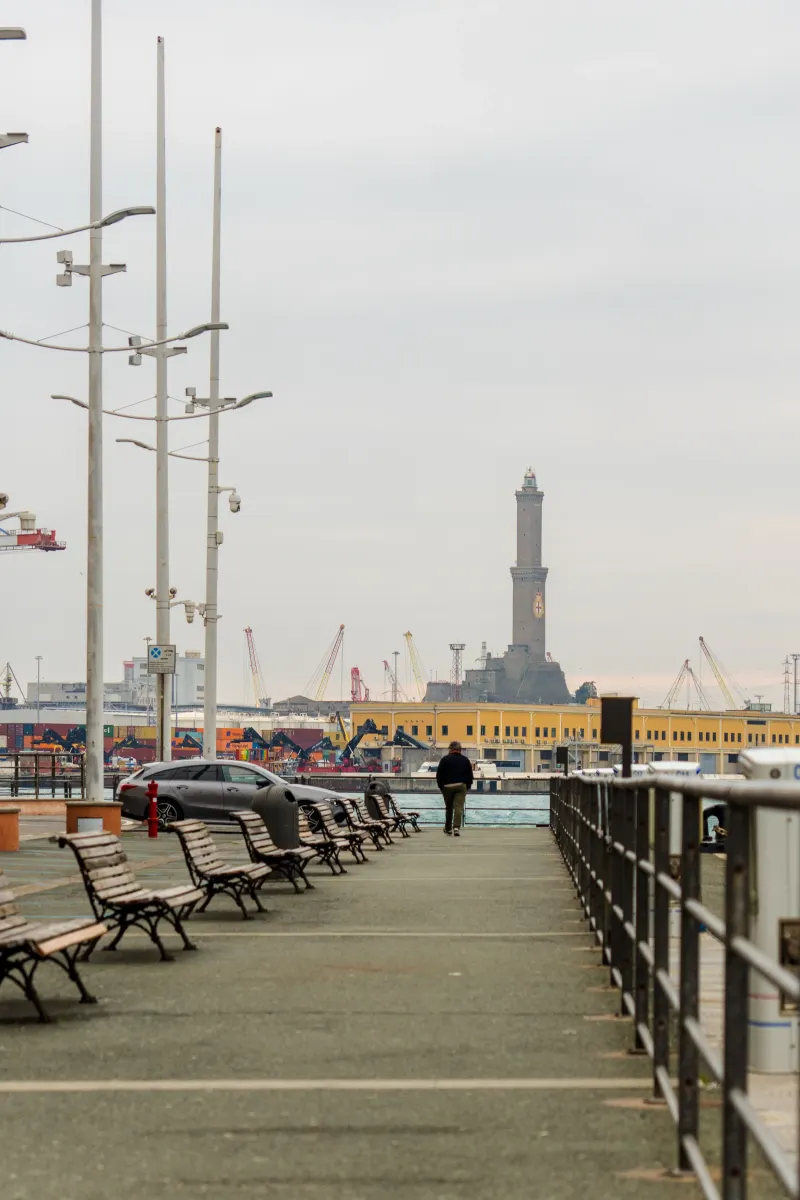
Stand anywhere on the waterfront of Genoa and look west. Rising from a rocky promontory above the tangle of cranes, container ships and medieval rooftops, you will see a white tower that seems too tall to be real. That is the Lanterna — the lighthouse that has guided sailors into the port of Genoa since 1128, making it one of the oldest working lighthouses in the world and, at 77 metres above sea level (the tower itself stands 40 metres above the rocky cliff it sits on), the tallest lighthouse in the entire Mediterranean.
Its light reaches 50 kilometres out to sea. For centuries, spotting the Lanterna on the horizon meant you had made it — you had survived the open water, the storms, the uncertainty, and Genoa's port was within reach. That weight of meaning has never quite left the place. Even today, Genoese people will tell you they feel a specific pang of recognition — something close to relief — whenever they see the Lanterna coming into view.
A History Written in Stone and Olive Oil
The story of the Lanterna begins in the early twelfth century, when Genoa was one of the dominant maritime republics of the Mediterranean world. The city's merchants had trading posts as far away as the Black Sea. The port was the engine of everything, and a lighthouse was not a luxury — it was infrastructure as critical as any harbour wall.
For most of its history, the Lanterna was fuelled not by gas or electricity but by olive oil. It was a practical choice: olive oil burned slowly and steadily, produced a reliable flame, and was produced in abundance across Liguria. The keepers who tended the light lived a strange, isolated existence on the promontory, responsible for one of the most important signals in the western Mediterranean.
The tower did not survive the Middle Ages unscathed. During the violent conflicts between the Guelph and Ghibelline factions that periodically tore Genoa apart, the Lanterna was damaged, partly destroyed, and rebuilt. Each reconstruction left its mark. The form you see today — two octagonal towers stacked one on top of the other, the lower one broad and fortress-like, the upper one slender and refined — reflects centuries of repairs, reinforcements and architectural decisions made under pressure.
In 2001, a new element was added: an 800-metre external walkway that traces the route of the ancient western access road, the path people once took when the lighthouse stood entirely outside the city walls, on a windswept headland. That walkway has become one of the finest waterfront walks in Genoa.
What to See and Do
A visit to the Lanterna is more layered than most people expect. The site offers four distinct itineraries, each with a different focus and a different physical demand.
- The fortress ruins and museum: before reaching the lighthouse itself, you pass through what remains of the defensive fortifications that once protected the headland. A small museum inside holds historical maps, documents and artefacts that trace the Lanterna's military as well as maritime history.
- The lighthouse climb: 365 steps to the top — one for every day of the year, according to local tradition. The staircase is narrow and the stone is worn smooth by centuries of keepers' boots. The reward at the top is a panoramic view over the entire port, the historic centre, the Apennine hills, and — on clear days — as far as Monte di Portofino. If 365 steps sounds ambitious, the panoramic terrace is reachable at step 172.
- The open-air museum: a ground-level circuit with installations, interpretive panels and sculptures telling the history of the lighthouse and the port. Ideal for families with young children, or anyone who prefers to absorb the atmosphere without tackling the stairs.
- The 800-metre external walkway: following the old western approach road along the edge of the promontory, with views over the working port on one side and the hills of Genoa on the other. It is at its most dramatic at sunset, when the light turns the sea copper and the Lanterna casts long shadows across the water.
Inside the site, do not miss the museum of maritime relics — anchors from different eras, cannons recovered from the seabed, navigation instruments spanning several centuries. It is a quietly absorbing collection that tells you as much about Genoa's seafaring culture as any written history could.
One modern detail worth noting: the Lanterna's light occasionally changes colour for special occasions, illuminating the tower in different hues to mark awareness campaigns or significant civic moments. It is a small gesture that keeps a nine-century-old monument connected to the present.
Getting There: Practical Information
Tickets are best purchased in advance at lanternadigenova.com, where you will also find up-to-date opening hours. These vary between summer and winter seasons, and occasional closures for maintenance or events are possible.
By car, take the Genova Ovest motorway exit and follow signs for the Terminal Traghetti. Parking is available there and the walk to the Lanterna takes only a few minutes. Be aware that the port area can be confusing to navigate, especially on busy embarkation days — allow extra time.
By public transport, the metro to Dinegro station is the cleanest option, leaving you with a pleasant 10–15 minute walk to the promontory. Alternatively, bus line 1 stops directly at the Lanterna stop.
If your schedule allows, plan to arrive in the hour before sunset. The late afternoon light does something remarkable to the view from the top of the tower — and the walk back along the external promenade, with the lighthouse beam beginning its nightly rotation behind you, is the kind of travel memory that tends to stick.
Stay on the Ligurian Riviera with CasaViva
Planning your trip? CasaViva offers hand-picked apartments in Camogli, Rapallo, Santa Margherita Ligure and Genoa. Book directly — best rates guaranteed, no commission fees.
Browse available apartments →